Longevity
Epithalon dosage explained: no approved human dose exists, animal study doses do not translate to people, and forum protocols are anecdotes, not data.
There is no approved human epithalon dosage. FDA has never approved epithalon as a drug, and on 24 July 2026 its compounding advisory panel only recommended, by 7-4, that the peptide be considered for the list pharmacies may use. That recommendation set no dose and allowed no compounding yet.
Epithalon dosages that can be seen in forums and offered by certain sellers are constantly searched by people. This page explains what makes that information irrelevant in terms of regulatory or clinical matters, how it came to be, and what our approach is instead. We do not disclose dosages, schedules, or any other prescriptions. Epithalon is made available for research purposes and is not intended for use in medicine.
A dose is deemed "approved" only after regulators verify controlled human trials proving what dose can be safely used for a particular purpose. To date, Epithalon has not undergone that kind of process in the US.
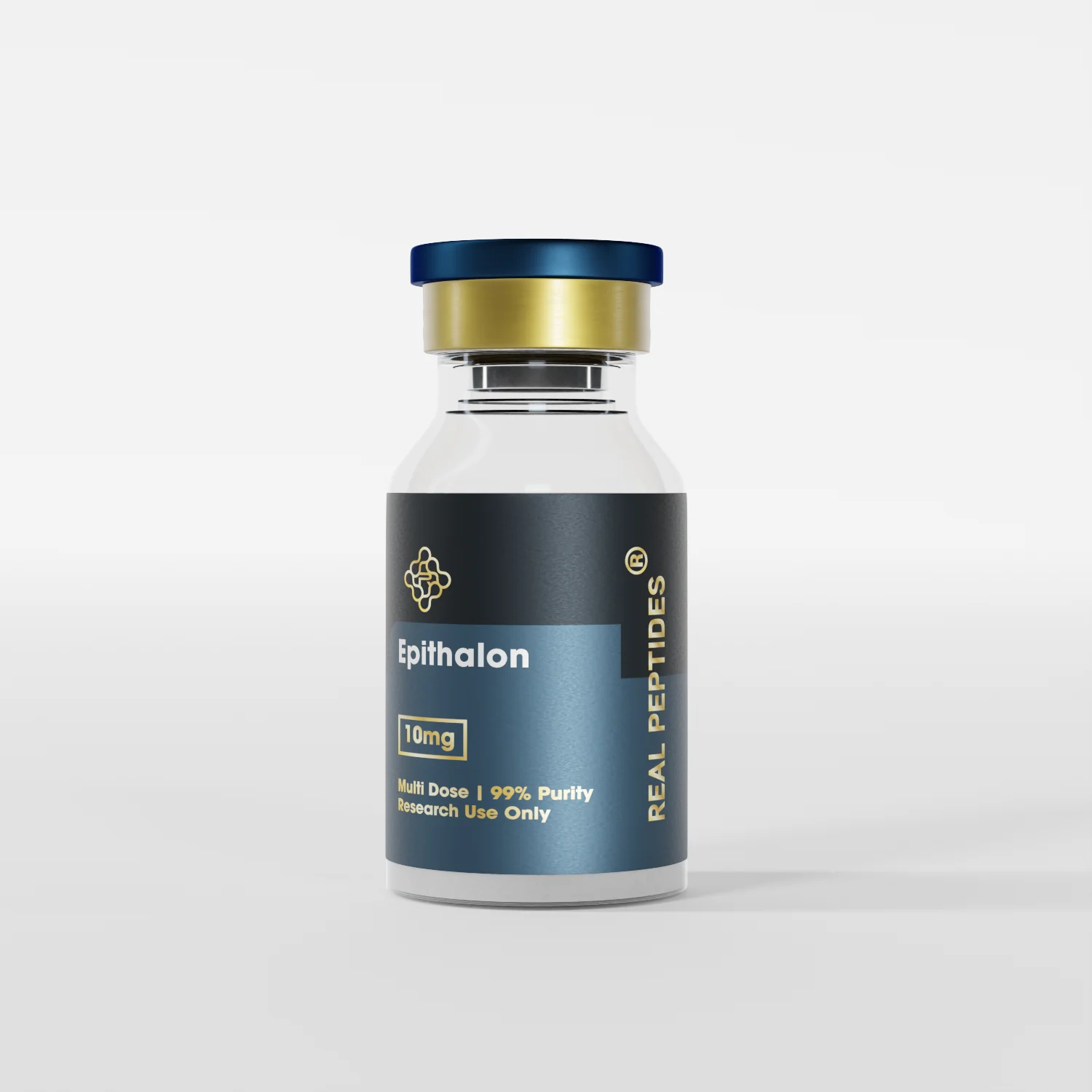
Without approval, no label, no prescribing information and no official dose exists. The research vendors we track sell epithalon as lyophilized powder, and the only number on the listing is the vial size, for example the 10 mg vial Real Peptides lists at $24.00. That figure is a product spec, like the weight on a bag of reagent. It is not a dose.
Epithalon research primarily consists of rodent studies and in vitro work, with only a handful of studies in aged human subjects in Russia. Animal studies are done with doses suited for rats and mice, and these cannot be converted with any reliability to human doses.
Body mass, metabolism, how fast a peptide is broken down, and the route used all differ between species. Scaling formulas exist for drug development, but they are a starting point for designing a human safety trial, not a substitute for one. That trial has not been published for epithalon. The small human reports also do not meet the design standards a regulator would use to set a dose. We cover what each study type can and cannot show on our epitalon benefits page.
What is referred to as the “protocols” on websites and social networks is nothing but mere personal testimonies. These have usually been copied from one commentary to another, losing their origin in the process.
Several problems come up again and again:
A widely repeated epithalon dosage figure is still just a repeated anecdote.
The dosage information given on a seller's website is viewed by the FDA as proof that the product is meant for human consumption, according to the warning letters sent by the FDA to five companies that sell peptides over the internet on the 24th of August, 2026.
In those letters FDA said a "research use only" label does not settle the question. It looked at the whole site, and it treated disease claims, dosing guidance, reconstitution calculators and bacteriostatic water sold next to injectables as signs the products were really meant for people. Epithalon was not among the products named in those letters, but the reasoning applies to any site that sells it. A vendor that publishes a dosing chart is taking on that risk, and buyers should read it as a warning sign about the seller. More on the regulatory picture is on our FDA 2026 page.
The prescriber determines the dose for prescription medication for a designated patient. Such is the case with prescription NAD+ via telemedicine: a physician's visit comes first, and only after that the pharmacy-generated product comes into the picture.
Epithalon has not reached this status. Even if its inclusion into the 503A bulks list by the FDA would follow the necessary procedure, it is nothing more than a decision taken by a prescribing practitioner in consideration of an individual patient. Until this moment, there really is no authentic answer concerning any question about the dose of epithalon that might be given. If you have any questions concerning your health, you should consult with your physician.
We stick to specifications that a buyer can verify. For all listings, that means the vial size where indicated, the shape, any testing documents, the price and price per mg, and the terms of the vendor.
| What we publish | What we do not publish |
|---|---|
| Vial size as a product spec (10 mg) | Amounts for use, in any unit |
| Price per mg ($2.40 at Real Peptides) | Schedules, frequency or duration |
| COA and purity claims | Mixing or preparation steps |
| Shipping and returns terms | Any suggestion of human use |
We take this line because it is the only one the evidence supports. The price comparison lives on our epithalon vendors page.
There is no approved human epithalon dosage. FDA has never approved epithalon as a drug, and on 24 July 2026 its compounding advisory panel only recommended, by 7-4, that the peptide be considered for the list pharmacies may use. That recommendation set no dose and allowed no compounding yet.
Epithalon dosages that can be seen in forums and offered by certain sellers are constantly searched by people. This page explains what makes that information irrelevant in terms of regulatory or clinical matters, how it came to be, and what our approach is instead. We do not disclose dosages, schedules, or any other prescriptions. Epithalon is made available for research purposes and is not intended for use in medicine.
A dose is deemed "approved" only after regulators verify controlled human trials proving what dose can be safely used for a particular purpose. To date, Epithalon has not undergone that kind of process in the US.
Without approval, no label, no prescribing information and no official dose exists. The research vendors we track sell epithalon as lyophilized powder, and the only number on the listing is the vial size, for example the 10 mg vial Real Peptides lists at $24.00. That figure is a product spec, like the weight on a bag of reagent. It is not a dose.
Epithalon research primarily consists of rodent studies and in vitro work, with only a handful of studies in aged human subjects in Russia. Animal studies are done with doses suited for rats and mice, and these cannot be converted with any reliability to human doses.
Body mass, metabolism, how fast a peptide is broken down, and the route used all differ between species. Scaling formulas exist for drug development, but they are a starting point for designing a human safety trial, not a substitute for one. That trial has not been published for epithalon. The small human reports also do not meet the design standards a regulator would use to set a dose. We cover what each study type can and cannot show on our epitalon benefits page.
What is referred to as the “protocols” on websites and social networks is nothing but mere personal testimonies. These have usually been copied from one commentary to another, losing their origin in the process.
Several problems come up again and again:
A widely repeated epithalon dosage figure is still just a repeated anecdote.
The dosage information given on a seller's website is viewed by the FDA as proof that the product is meant for human consumption, according to the warning letters sent by the FDA to five companies that sell peptides over the internet on the 24th of August, 2026.
In those letters FDA said a "research use only" label does not settle the question. It looked at the whole site, and it treated disease claims, dosing guidance, reconstitution calculators and bacteriostatic water sold next to injectables as signs the products were really meant for people. Epithalon was not among the products named in those letters, but the reasoning applies to any site that sells it. A vendor that publishes a dosing chart is taking on that risk, and buyers should read it as a warning sign about the seller. More on the regulatory picture is on our FDA 2026 page.